Sleep apnea awareness: ResMed set out to increase consumer awareness of the prevalence of sleep apnea.
Holographic engagement: HanHan, the brand mascot, was brought to life through a holographic experience at the ResMed Café in Shanghai.
Digital conversion journey: A QR code connected the physical activation to a campaign page where visitors could learn more and sign up for a sleep test.
CRM connection: Participants were encouraged to follow the official WeChat account and enter the CRM programme.
Sleep apnea awareness is ultimately about helping consumers recognise a health issue and giving them a clear next step. ResMed, the leader in OSA (sleep apnea) solutions, wanted to create greater awareness of sleep apnea by connecting an engaging physical experience with a digital consumer journey.
For the campaign developed by Fugu, the response was not built around information alone. The campaign used HanHan, ResMed’s mascot, as the centre of an interactive physical experience at the ResMed Café. This was a first-of-its-kind holographic experience, designed to turn the mascot into a more immediate and engaging presence for visitors.
The experience was then connected to a clear digital journey. Visitors were encouraged to scan a QR code, move to a campaign page, learn more about sleep apnea and register for a sleep test. The journey continued through ResMed’s official WeChat account, where participants could become part of the brand’s CRM programme.
The result linked a technology-led retail activation with education and customer relationship building and drove a 20%+ increase in store visits.
The campaign brief was straightforward: increase consumer awareness of the prevalence of sleep apnea. The more difficult part was turning that awareness objective into something consumers would notice, understand and act on in a physical retail setting.
The activation needed to attract attention at the ResMed Café located in a high footfall commercial street and make the subject approachable enough for consumers to engage with it and then create a simple route from interest to further information and a sleep-test sign-up.
This meant the campaign needed to do more than create a visually interesting installation. It had to connect the physical experience to a meaningful consumer action and, beyond that, to an ongoing brand relationship through WeChat and CRM.
The campaign therefore needed to:
Create an attention-grabbing experience around a health-awareness message.
Use the HanHan mascot in a way that felt engaging and true to the character.
Give visitors an easy way to learn more about sleep apnea after the physical interaction.
Turn awareness into a measurable action through sleep-test registration.
Extend the relationship beyond the store by connecting participants to ResMed’s official WeChat account and CRM programme.
The central idea was to bring Han Han to life through a holographic experience inside the ResMed Café in Shanghai. Instead of asking consumers to begin with a medical message, the campaign gave them a character-led experience that could first attract attention and then lead them toward education about sleep apnea.
HanHan was not treated as a static graphic. Fugu created and animated the character so that he behaved like the “lovable rascal” he is. This gave Han Han a role within the experience rather than simply using him as decoration.
From a campaign-design perspective, this created a useful bridge between technology and health communication. The holographic element provided the visual hook. Han Han made the interaction recognisable and approachable. The QR-driven campaign page then provided the space for more detailed information and the sleep-test call to action.
The idea can be understood as a connected journey rather than a standalone installation:
This was important because the physical activation was not the end point. It was the entry point into a wider consumer journey.
The campaign was designed as an end-to-end experience combining a physical activation at the ResMed Café with a digital education and conversion path.
The most visible part of the activation was the holographic presentation of Han Han at the ResMed Café in Shanghai. Its role was to create a distinctive in-store moment around the campaign and give consumers a reason to stop and engage.
The use of Han Han also helped give the technology a clear brand role. Rather than presenting holographic technology as a standalone novelty, the experience centred on a character already associated with ResMed.
Fugu handled the experience from the creation of Han Han through to his animation. The aim was to make him behave like the lovable rascal that he is.
That detail matters because character behaviour influences how a branded experience feels. A mascot that simply appears on screen is very different from a mascot that seems to have movement and personality. In this campaign, animation helped make Han Han an active part of the experience and supported the more approachable tone of the activation.
The physical activation was connected to a digital call to action. Visitors could scan a QR code and arrive on a campaign page where they could learn more about sleep apnea.
This provided a natural handover from the short, attention-led retail moment to deeper information. The holographic experience did not need to carry the full educational burden. Instead, it created interest and directed consumers toward a channel better suited to explaining the condition in more detail.
The campaign page also allowed users to sign up for a sleep test. This gave the awareness campaign a practical next step. Rather than ending with passive exposure to a health message, consumers who wanted to explore the issue further had a direct action available to them.
Participants were also encouraged to follow ResMed’s official WeChat account and become part of the CRM programme. This extended the campaign beyond the immediate café visit and created an owned-channel connection with interested consumers.
The structure is particularly relevant in the China market because the campaign did not leave the interaction isolated in an offline space. The QR journey and WeChat follow provided a mechanism for the brand to continue communicating with participants after the initial experience.
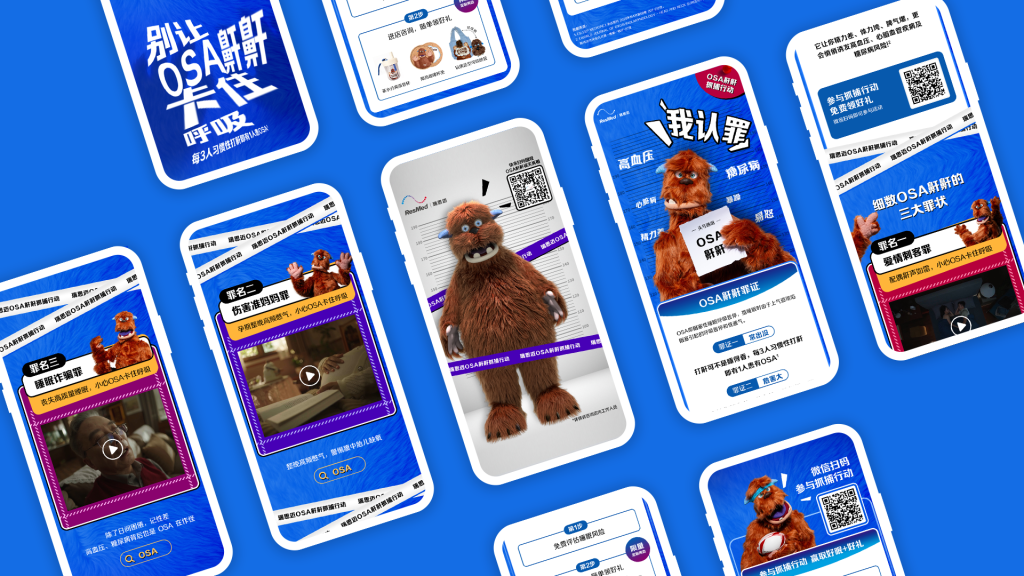
The campaign did not rely only on informational content. By placing a holographic experience inside the ResMed Café, it turned the awareness objective into something consumers could encounter directly in a physical space.
Han Han gave the technology a recognisable face. Bringing the mascot to life through animation created a more approachable entry point before asking consumers to engage with a health topic.
The QR code linked the attention-grabbing activation to deeper information. Consumers who became interested could immediately move to the campaign page, learn more about sleep apnea and register for a sleep test.
Encouraging participants to follow the official WeChat account meant the campaign could continue beyond the café visit. The CRM connection gave the activation a longer-term role rather than treating each interaction as a one-off event.
The strongest part of the concept was not simply that it used a hologram. The technology had a defined place in the journey: attract attention first, then guide consumers toward education and action. This kept the experience connected to the campaign objective rather than making technology the objective itself.
The ResMed Holobox Campaign shows how a health-awareness message can be translated into a more engaging retail experience when technology is connected to a clear consumer journey.
By bringing Han Han to life as a holographic character at the ResMed Café in Shanghai, the activation linked creativity with a practical business outcome with a significant double digit increase in store visits.
Sleep apnea awareness: ResMed set out to increase consumer awareness of the prevalence of sleep apnea.
Holographic engagement: HanHan, the brand mascot, was brought to life through a holographic experience at the ResMed Café in Shanghai.
Digital conversion journey: A QR code connected the physical activation to a campaign page where visitors could learn more and sign up for a sleep test.
CRM connection: Participants were encouraged to follow the official WeChat account and enter the CRM programme.
Sleep apnea awareness is ultimately about helping consumers recognise a health issue and giving them a clear next step. ResMed, the leader in OSA (sleep apnea) solutions, wanted to build greater awareness among consumers about the prevalence of sleep apnea.
For the campaign developed by Fugu, the response was not built around information alone. The campaign used HanHan, ResMed’s mascot, as the centre of an interactive physical experience at the ResMed Café. This was a first-of-its-kind holographic experience, designed to turn the mascot into a more immediate and engaging presence for visitors.
The experience was then connected to a clear digital journey. Visitors were encouraged to scan a QR code, move to a campaign page, learn more about sleep apnea and register for a sleep test. The journey continued through ResMed’s official WeChat account, where participants could become part of the brand’s CRM programme.
The result linked a technology-led retail activation with education and customer relationship building and drove a 20%+ increase in store visits.
The campaign brief was straightforward: increase consumer awareness of the prevalence of sleep apnea. The more difficult part was turning that awareness objective into something consumers would notice, understand and act on in a physical retail setting.
The activation needed to attract attention at the ResMed Café located in a high footfall commercial street and make the subject approachable enough for consumers to engage with it and then create a simple route from interest to further information and a sleep-test sign-up.
This meant the campaign needed to do more than create a visually interesting installation. It had to connect the physical experience to a meaningful consumer action and, beyond that, to an ongoing brand relationship through WeChat and CRM.
The campaign therefore needed to:
Create an attention-grabbing experience around a health-awareness message.
Use the HanHan mascot in a way that felt engaging and true to the character.
Give visitors an easy way to learn more about sleep apnea after the physical interaction.
Turn awareness into a measurable action through sleep-test registration.
Extend the relationship beyond the store by connecting participants to ResMed’s official WeChat account and CRM programme.
The central idea was to bring Han Han to life through a holographic experience inside the ResMed Café in Shanghai. Instead of asking consumers to begin with a medical message, the campaign gave them a character-led experience that could first attract attention and then lead them toward education about sleep apnea.
HanHan was not treated as a static graphic. Fugu created and animated the character so that he behaved like the “lovable rascal” he is. This gave Han Han a role within the experience rather than simply using him as decoration.
From a campaign-design perspective, this created a useful bridge between technology and health communication. The holographic element provided the visual hook. Han Han made the interaction recognisable and approachable. The QR-driven campaign page then provided the space for more detailed information and the sleep-test call to action.
The idea can be understood as a connected journey rather than a standalone installation:
This was important because the physical activation was not the end point. It was the entry point into a wider consumer journey.
The campaign was designed as an end-to-end experience combining a physical activation at the ResMed Café with a digital education and conversion path.
The most visible part of the activation was the holographic presentation of Han Han at the ResMed Café in Shanghai. Its role was to create a distinctive in-store moment around the campaign and give consumers a reason to stop and engage.
The use of Han Han also helped give the technology a clear brand role. Rather than presenting holographic technology as a standalone novelty, the experience centred on a character already associated with ResMed.
Fugu handled the experience from the creation of Han Han through to his animation. The aim was to make him behave like the lovable rascal that he is.
That detail matters because character behaviour influences how a branded experience feels. A mascot that simply appears on screen is very different from a mascot that seems to have movement and personality. In this campaign, animation helped make Han Han an active part of the experience and supported the more approachable tone of the activation.
The physical activation was connected to a digital call to action. Visitors could scan a QR code and arrive on a campaign page where they could learn more about sleep apnea.
This provided a natural handover from the short, attention-led retail moment to deeper information. The holographic experience did not need to carry the full educational burden. Instead, it created interest and directed consumers toward a channel better suited to explaining the condition in more detail.
The campaign page also allowed users to sign up for a sleep test. This gave the awareness campaign a practical next step. Rather than ending with passive exposure to a health message, consumers who wanted to explore the issue further had a direct action available to them.
Participants were also encouraged to follow ResMed’s official WeChat account and become part of the CRM programme. This extended the campaign beyond the immediate café visit and created an owned-channel connection with interested consumers.
The structure is particularly relevant in the China market because the campaign did not leave the interaction isolated in an offline space. The QR journey and WeChat follow provided a mechanism for the brand to continue communicating with participants after the initial experience.
The campaign did not rely only on informational content. By placing a holographic experience inside the ResMed Café, it turned the awareness objective into something consumers could encounter directly in a physical space.
Han Han gave the technology a recognisable face. Bringing the mascot to life through animation created a more approachable entry point before asking consumers to engage with a health topic.
The QR code linked the attention-grabbing activation to deeper information. Consumers who became interested could immediately move to the campaign page, learn more about sleep apnea and register for a sleep test.
Encouraging participants to follow the official WeChat account meant the campaign could continue beyond the café visit. The CRM connection gave the activation a longer-term role rather than treating each interaction as a one-off event.
The strongest part of the concept was not simply that it used a hologram. The technology had a defined place in the journey: attract attention first, then guide consumers toward education and action. This kept the experience connected to the campaign objective rather than making technology the objective itself.
The ResMed Holobox Campaign shows how a health-awareness message can be translated into a more engaging retail experience when technology is connected to a clear consumer journey.
By bringing Han Han to life as a holographic character at the ResMed Café in Shanghai, the activation linked creativity with a practical business outcome with a significant double digit increase in store visits.